Interior photographers talk constantly about small spaces. Almost nobody talks about the exterior version of the same problem: a home built so close to its neighbors that there is nowhere to stand and photograph the front of it. Zero-lot-line homes, narrow-lot infill, and side yards you can barely walk through are everywhere in newer Orlando, Tampa Bay, and Central Florida neighborhoods, and just as common in Austin and San Antonio.
The house itself may be excellent. The photographic problem is geometry. Here is what goes wrong on these exteriors and what can be done about each part of it.
The Front Elevation You Cannot Back Up From
A conventional front exterior is photographed from across the street or the far edge of the lot, far enough back that the roofline and both corners fit without the lens working hard. On a narrow lot with a short setback, that distance does not exist. The sidewalk is ten feet from the garage door, the street is right behind it, and backing up further puts a parked car, a mailbox cluster, or a neighbor's hedge in the foreground.
Three approaches usually carry the frame:
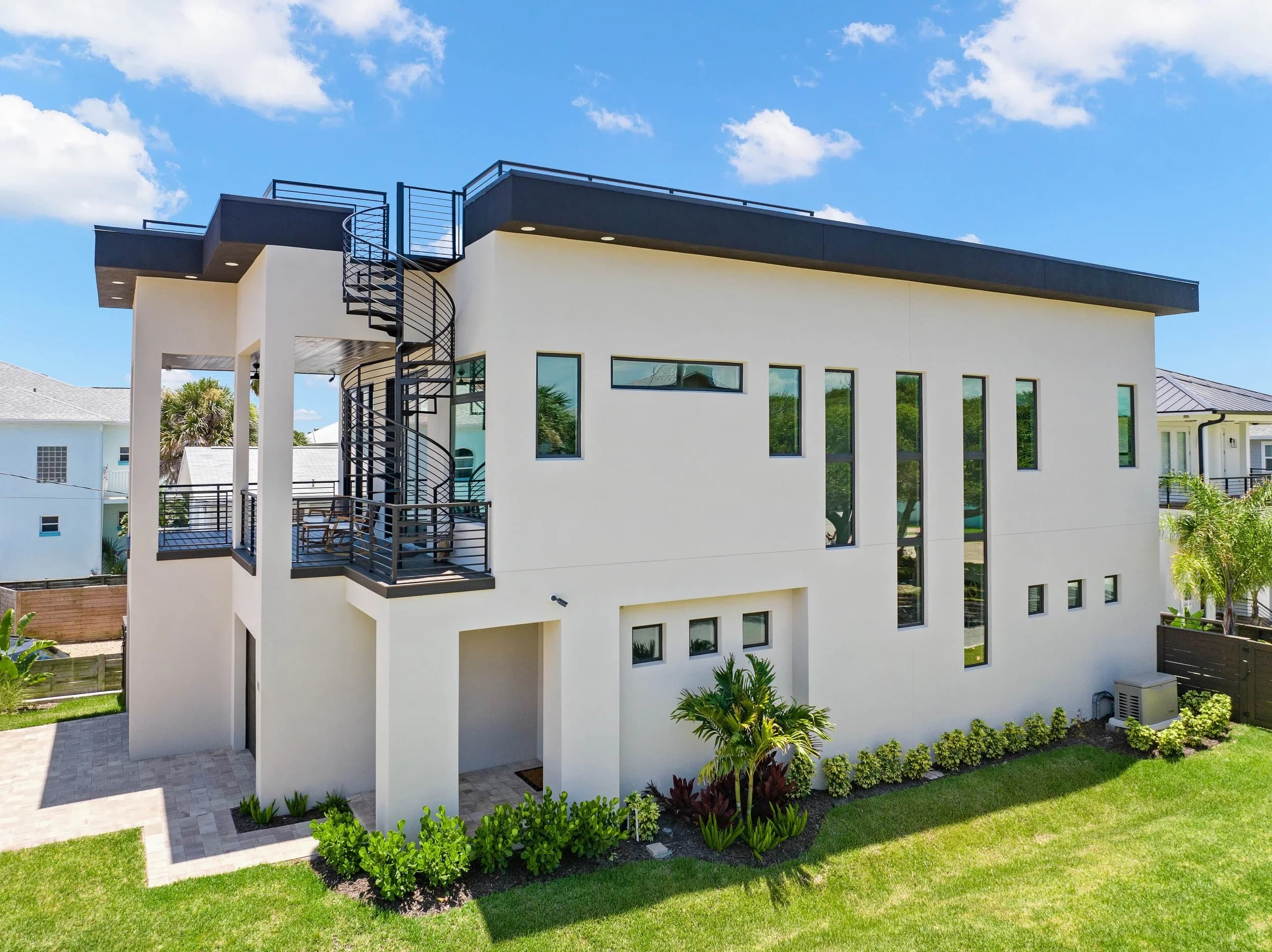
- Shoot the corner, not the face. A three-quarter angle from the property line needs far less distance than a straight-on elevation and shows depth the flat view cannot.
- Move up the street, not back from it. Photographing at a shallow angle from a few houses down compresses the frame and often produces a cleaner result than a cramped straight-on attempt.
- Raise the camera. A higher vantage point clears parked cars and low landscaping and keeps the roofline from stacking against the background.
What does not work is simply going wider. A very wide lens at close range stretches the corners of the house, bows the garage door, and makes the elevation look nothing like it does in person. That is the same distortion trap covered in wide-angle versus fisheye lens choice, and on tight lots it is the most common failure by far.
Leaning Walls Are a Tight-Lot Symptom
When the camera has to tilt upward to get the roof into frame, the vertical lines of the house converge and the walls appear to fall backward. On a normal lot this is easy to avoid by standing further back and keeping the camera level. On a narrow lot there is often no choice but to tilt, so the correction has to be deliberate rather than accidental.
Keeping the camera level and composing with extra space above the roofline, then correcting afterward, preserves straight verticals at the cost of some resolution. It is the right trade on a tight exterior. The mechanics are covered in why the walls lean in your listing photos.
The Neighbor's House Is in Your Photo
On a zero-lot-line home, one wall sits on or within a few feet of the property line. Any frame that includes the side of the house includes the neighbor's wall, window, air conditioning unit, or fence. No angle removes it.
The honest approach is to decide what the neighbor's structure is doing in the composition rather than pretending it is not there:
- If the side yard is a real amenity — a courtyard, a private patio, a garden strip — photograph it as its own space, framed tight enough that the boundary reads as an enclosure rather than an intrusion.
- If the side yard is purely utility, one documentary frame is enough.
- Never crop or edit so aggressively that a buyer arriving in person is surprised by how close the next house is. A gallery that oversells the separation costs a showing, and possibly trust.
This is the exterior cousin of the judgment call in photographing a home that backs to a busy road: show the condition clearly in one frame and let the rest of the gallery sell what is genuinely good.
When an Aerial Is the Only Honest Establishing Frame
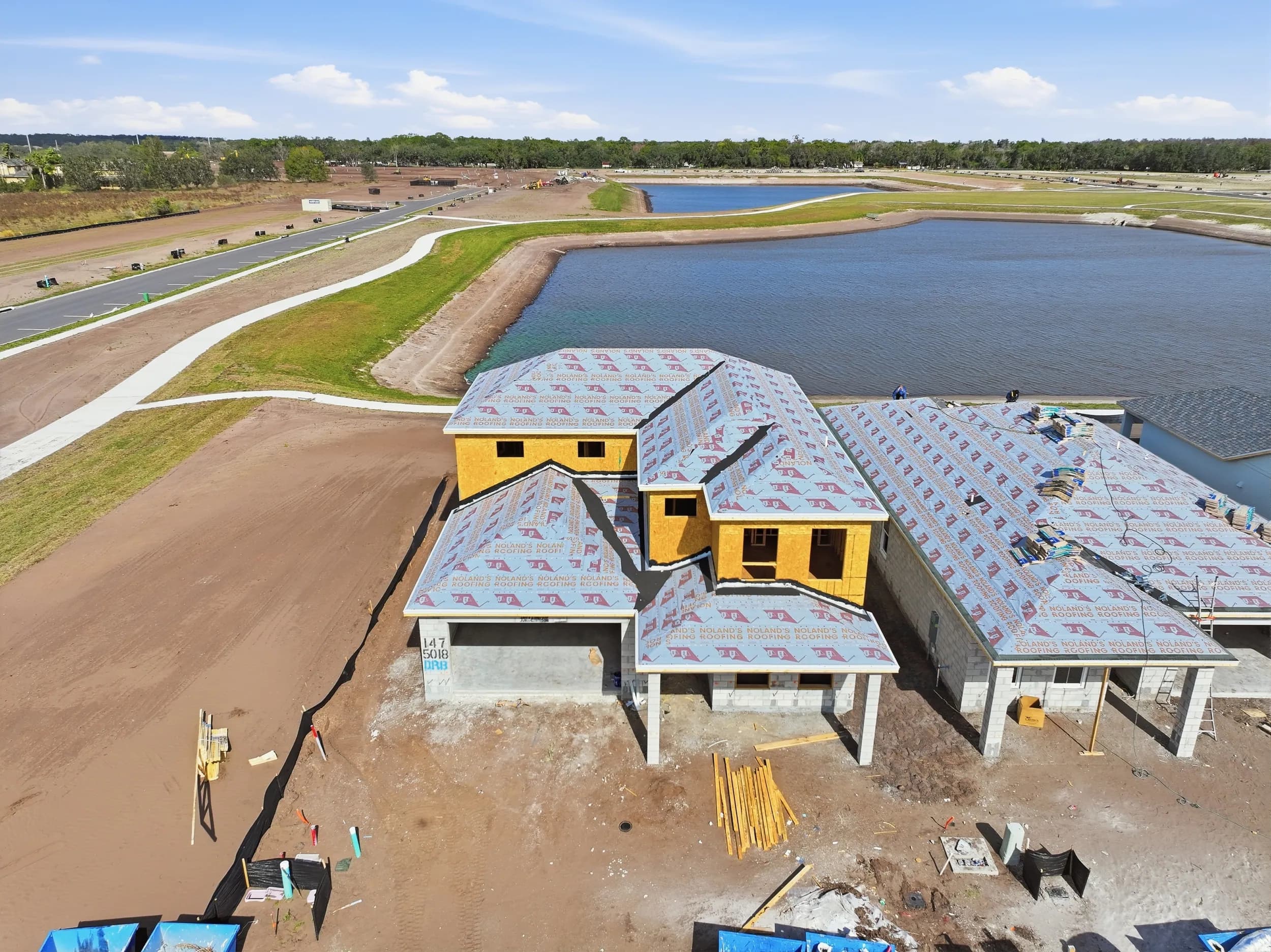
On some tight lots there is no ground-level position that shows the house as a whole — the street is too narrow, the trees are too close, or the front is blocked by a neighbor's mature landscaping. A low aerial from thirty or forty feet, angled down slightly, often solves in one frame what six ground attempts cannot. It clears the parked cars, shows the roofline intact, and puts the home in the context of its block.
This is a different use of the drone than neighborhood marketing. It is not about the lake two streets over; it is one clean establishing view of the property itself. Airspace restrictions and community rules still apply, and in some locations an aerial is not available at all, so treat it as a likely solution rather than a guaranteed one.
Townhomes and Attached Product Have Their Own Version
Attached homes take the narrow-lot problem one step further: there are no side elevations at all, and the unit being marketed looks identical to the four beside it. The front exterior has to make clear which door is the subject, usually through angle, the house number, and a frame tight enough that the neighboring units read as context instead of competition. End units and interior units also photograph differently, and a gallery that does not distinguish them invites confusion.
Builders marketing attached product at scale will find the builder's guide to townhomes and attached homes covers the community-level version of this, where consistency across many near-identical units is the real challenge.
Tight lots are not a reason to accept a weak exterior. They just mean the front of the house is solved with angle, camera height, and sometimes altitude rather than with distance. Delivery timing is confirmed at booking. If you have a narrow-lot or zero-lot-line listing coming up, it helps to mention it when you book so the approach is planned in advance. Ready to book? Call or text (689) 600-2131 or get in touch.