Some of the most desirable streets in Central Florida are the ones buried under mature live oaks. Winding, shaded, canopied end to end — exactly the kind of neighborhood buyers drive through and fall in love with. And exactly the kind of setting that makes a clean exterior photograph unusually difficult.
Agents notice the result without always naming the cause. The interiors came back beautifully and the front of the house looks flat, green, and blotchy. That is not a processing failure. It is what happens when a camera meets a canopy, and it is a solvable problem if you plan for it instead of discovering it on site.
What a canopy actually does to the frame
Three things happen at once under heavy tree cover, and they compound.
Dappled light. Sun filtered through leaves lands on the facade in bright patches with hard-edged shadows between them. The dynamic range across a single wall can exceed what the sensor holds, so you either blow out the patches or lose the shade to black. Worse, the pattern is visually noisy — the eye reads it as mess rather than as light.
Green color cast. Light bouncing off a canopy of leaves arrives green. White trim goes celery. Warm stucco goes olive. Correcting it globally pushes the sky magenta, so the fix has to be selective and it is never entirely clean.
No clean elevation. Branches hang into the frame. Trunks sit between the camera and the house. Step back far enough to get the whole facade and you are shooting through foliage; step close enough to clear it and you are cropping the roofline. This is a geometry problem, not an exposure one.
Color casts under tree cover behave much like the ones we cover in why listing photos look yellow, orange, or green — the difference is that indoors the culprit is a light bulb you can switch off, and outdoors the culprit is fifty feet of oak you cannot.
Timing: overcast is the ally, not the enemy
The general rule for Florida exteriors is to shoot when the light is low and directional, and our guide to the best time of day for exterior photos lays out why. Under a heavy canopy, that rule partly inverts.
Direct sun is what creates the dappling. Take the direct sun away and the problem largely goes with it. So:
- A bright overcast sky is close to ideal. The canopy becomes a soft diffuser instead of a stencil, the facade lights evenly, and the green cast is milder because less light is bouncing through leaves.
- Full midday sun is the worst case — the highest contrast and the harshest leaf shadows of the day.
- Low evening light can work when the sun clears the canopy at a shallow angle and reaches the facade under the branches rather than through them — though that depends entirely on which way the house faces.
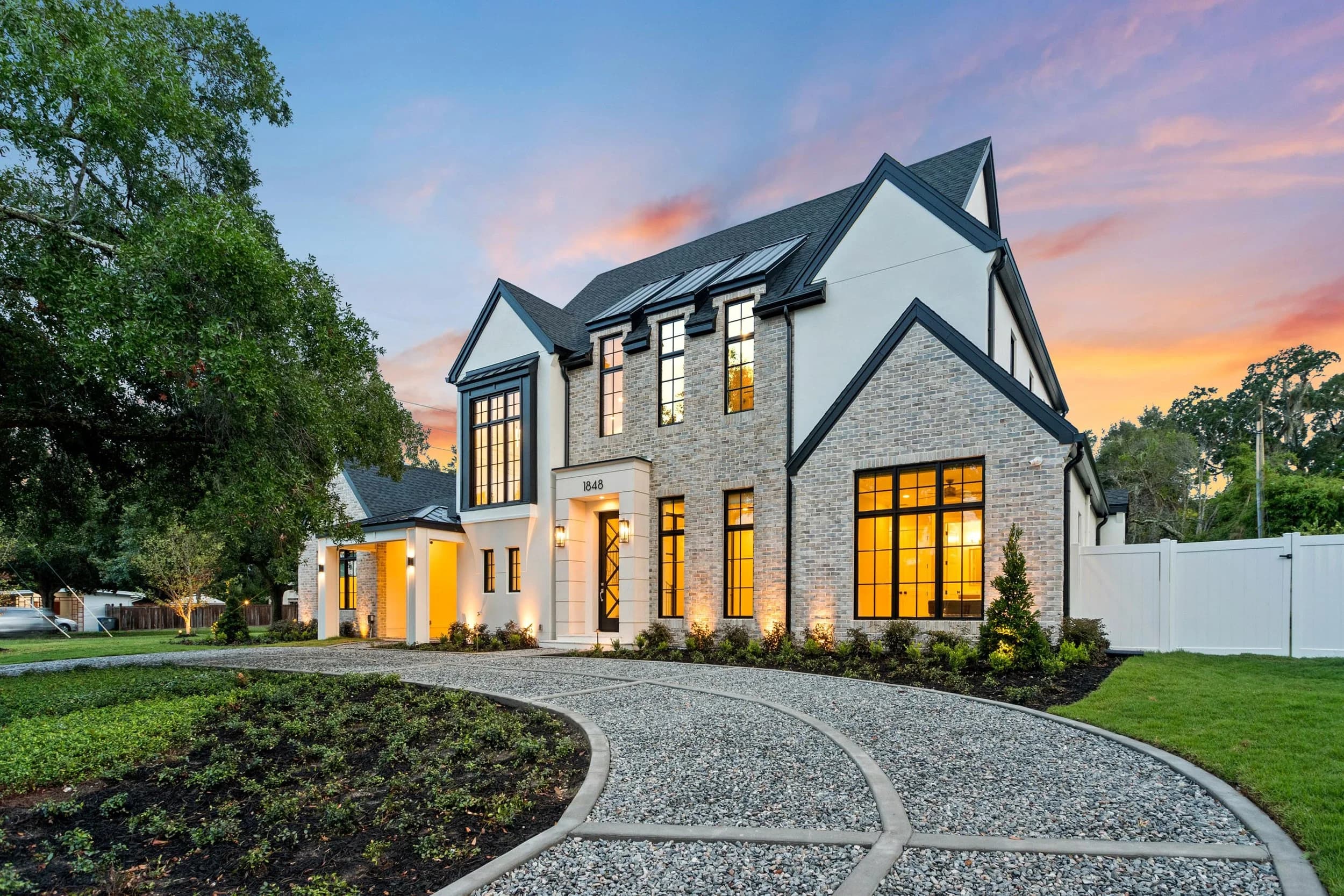
- Twilight is often the strongest option on a deeply shaded lot, because the house becomes the light source and the canopy turns into a frame instead of an obstacle.
That last point is worth taking seriously on the streets where the shade never really lifts. It is one of the few cases where twilight is less an upgrade and more the practical answer.
Position, and the front elevation problem
When the straight-on elevation is genuinely blocked, the honest move is to stop chasing it and change the shot.
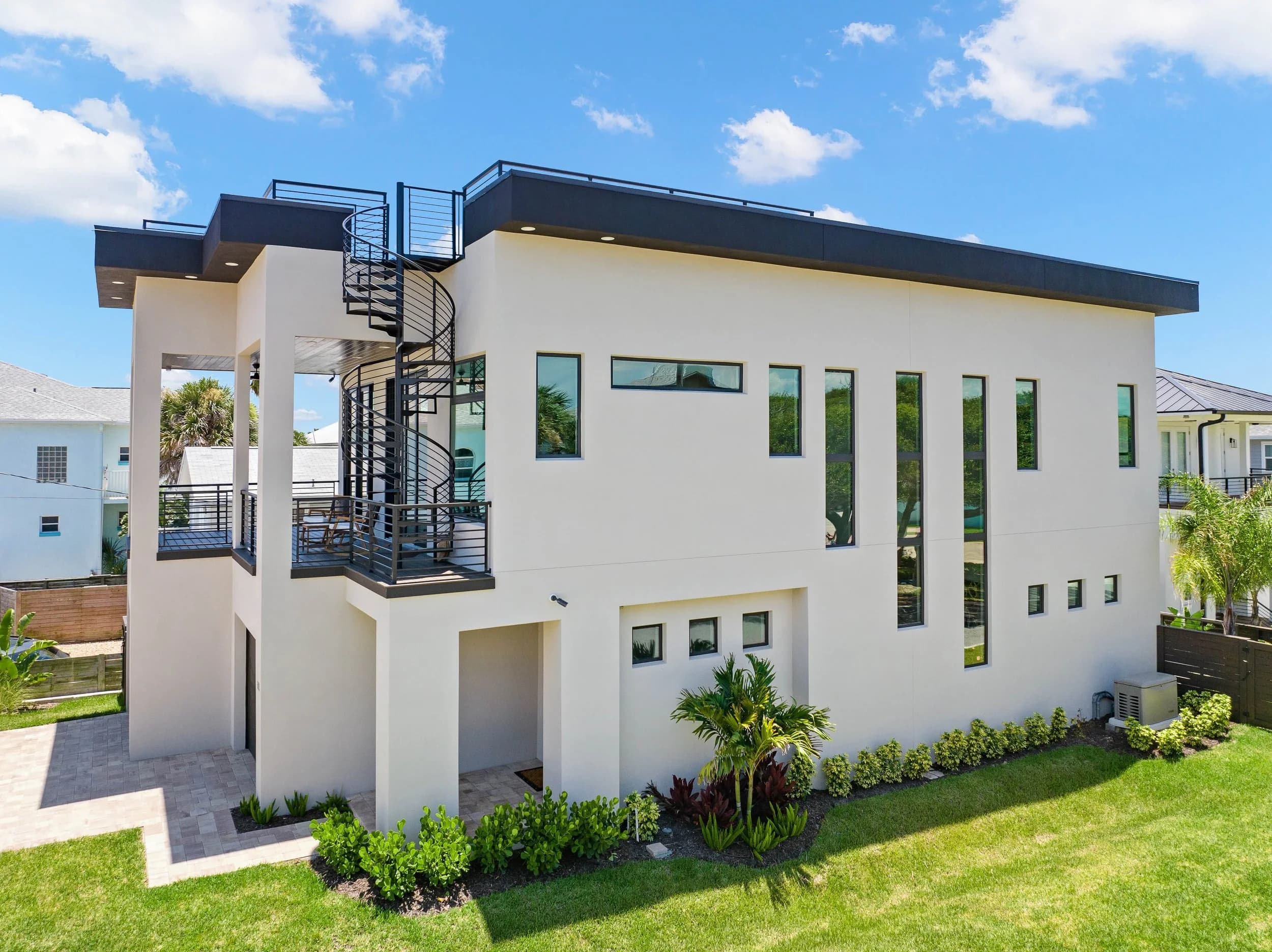
- Work the three-quarter angle. A corner view often clears foliage that a frontal view cannot, and it reads more dimensionally anyway.
- Use the trees deliberately. A branch across the top of the frame, in focus and intentional, looks like composition. The same branch clipping one corner looks like a mistake.
- Find the gap and commit to it. On most shaded lots there is one position where the facade is clear. It is worth ten minutes of walking to find it.
- Do not remove the trees in post. The shade is a feature of the property, buyers will see it in person, and the canopy is frequently part of why the home is worth what it is.
When the aerial is the only honest establishing frame
On a fully canopied lot, there are homes where no ground-level angle shows the house as a whole. A low aerial from above the tree line, angled down and in, gives you the establishing frame the street cannot — and shows the relationship between home, canopy, and lot besides.
This is a genuine editorial judgment rather than an add-on, and it belongs to the same family of decisions as the ones in our post on using location aerials to sell the neighborhood. One caution specific to canopy: the drone needs a clear vertical corridor to launch and climb through, and a dense oak canopy does not always provide one. That gets assessed on site.
What to tell the seller
A short conversation before the shoot prevents most disappointment. Trimming the two branches that hang lowest over the driveway can change the front elevation entirely, and clearing leaf litter from the walkway and roof edge matters more than usual, because flat shade offers no strong light to distract from it. It also helps to say plainly that a shaded exterior will not look like a sunlit one. That is the property, and pretending otherwise only defers the conversation.
For agents working the canopied neighborhoods across Orlando, Tampa Bay, and Central Florida, this comes up constantly, and it is worth flagging at booking so the shoot can be scheduled for the light the lot actually gets. Listing galleries are delivered within 24 hours, video in 48 to 72 hours. Larger properties take a little longer.
If you have a shaded listing coming up and you are not sure the exterior will hold together, it is worth a conversation before the shoot rather than after. Ready to book? Call or text (689) 600-2131 or get in touch.