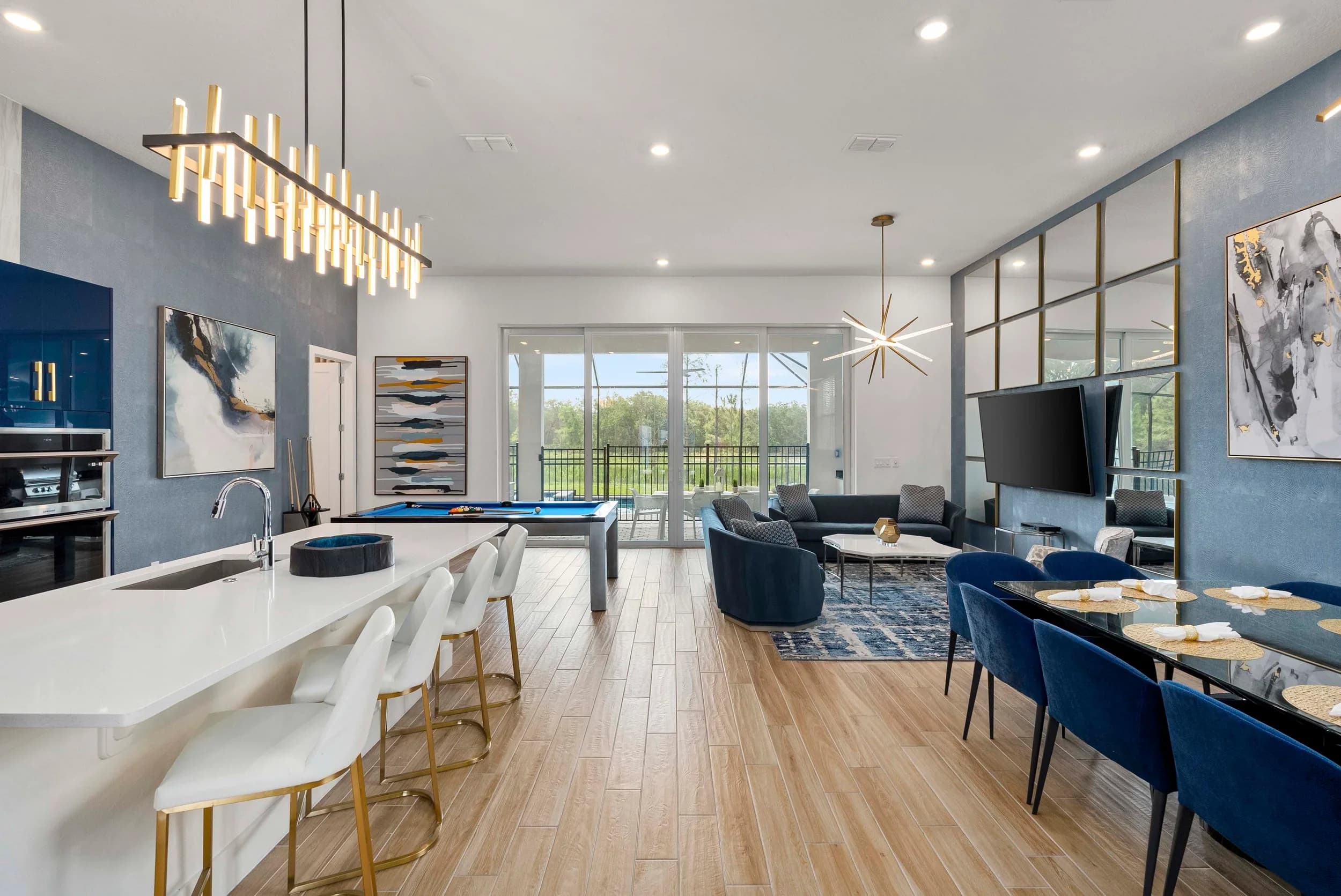
The resort-home market around Orlando is its own animal. Eight, ten, twelve bedrooms. A themed bunk room for the kids, a converted garage running arcade cabinets and a pool table, a home theater, a screened pool with a spa, and a floor plan that takes a guest two days to learn. These properties do not photograph like a single-family rental, and they do not photograph like a condo either.
The instinct is to treat a bigger house as the same shoot with more rooms in it. That is where resort-home galleries go wrong. Above a certain size the gallery stops being a tour and starts being a catalog, and a catalog has to be organized or the booking does not happen. Here is how to think about it.
The gallery is a room inventory, and guests read it like one
A family booking a ten-bedroom home is solving a logistics problem. Three couples, six kids, two grandparents, one of whom cannot manage stairs. They are not browsing for inspiration. They are counting beds, checking which rooms have a private bath, and working out who sleeps where before they will put money down.
That changes what the photography has to accomplish. Every sleeping space needs its own clear frame, not a representative one — "and four more bedrooms like this" is precisely the phrase that sends a guest to the next listing. In practice that means:
- Every bedroom photographed individually, with the bed configuration legible. A frame where you cannot tell a queen from a full is a frame that generates a message instead of a booking.
- Bunk rooms shot so the actual bunk count is countable. These rooms are tight and awkward and it is tempting to shoot a detail instead. Resist it.
- Bathrooms tied visually to the bedrooms they serve — shot in sequence, so the gallery order does the explaining.
- Ground-floor suites and any step-free sleeping space clearly shown, because accessibility is a real filter for these groups.
Themed rooms need to be photographed straight
Resort homes lean hard on themes. A superhero bunk room, a castle room, a space room. These are a genuine selling point and they are also the easiest thing in the house to over-photograph — kill the lights, shoot the murals lit only by the LED strip, and you get a dramatic frame that tells a guest nothing about the room.
The better approach is two frames per themed room. One honest, well-lit overall that shows scale, bed count, window, and how much floor is actually left. One atmospheric, closer, that sells the theme. Lead with the honest one. Guests who love the theme will still see it in the second frame, and guests who need to know whether a pack-and-play fits get their answer from the first.
One caution worth stating plainly: themed rooms often feature licensed characters painted on the walls, and how those images can be used in marketing is a question for the property owner and their management company, not for the photographer. Shoot the room; let the owner decide what goes in the listing.
Amenity stacks are the reason the booking happens
For resort homes, the amenities frequently outrank the bedrooms in the decision. The game room, the theater, the pool and spa, the outdoor kitchen, the arcade corner — these are what gets forwarded around the group chat.
Game rooms and theaters are difficult rooms. They are often converted garages with low ceilings, dark paint, no windows, and light sources that fight each other: a projector, a neon sign, an arcade cabinet's own screen. They need real lighting work rather than a bracketed exposure, and the screens need to be handled so they read as on without blowing out.
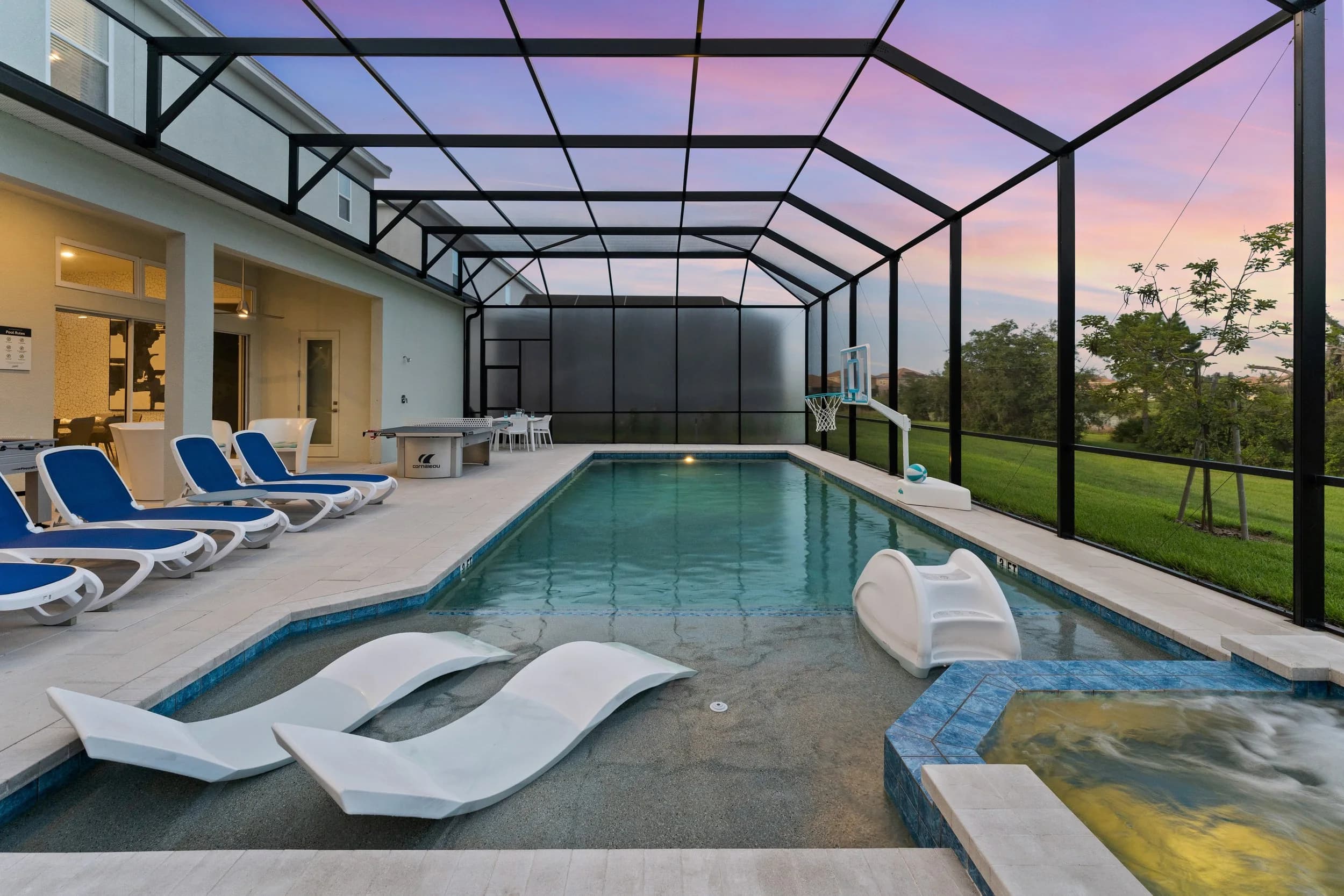
Pools and spas are the other half of the pitch, and Florida screen enclosures make them their own problem — the screen catches light, the frame cuts the sky, and a badly angled frame makes a generous pool look like a cage. There is a full post on photographing Florida pools, lanais, and screen enclosures that covers the technique; for a resort home, plan on both a daytime frame and a lit evening frame, because the evening pool is what most of these properties are actually selling.
Ordering ninety photos so the first eight do the work
A resort home can legitimately justify a very large gallery. That is fine — but almost no guest scrolls all of it before forming an opinion. The first handful decide whether they keep going.
A sequence that works for large properties:
- The pool and outdoor living space, lit, at dusk. This is usually the strongest single frame the house has.
- The main living and kitchen area, showing that the whole group can be in one room.
- The headline amenity — theater or game room.
- One or two signature themed bedrooms.
- Then the systematic run: every bedroom and bath in floor order, ground floor up.
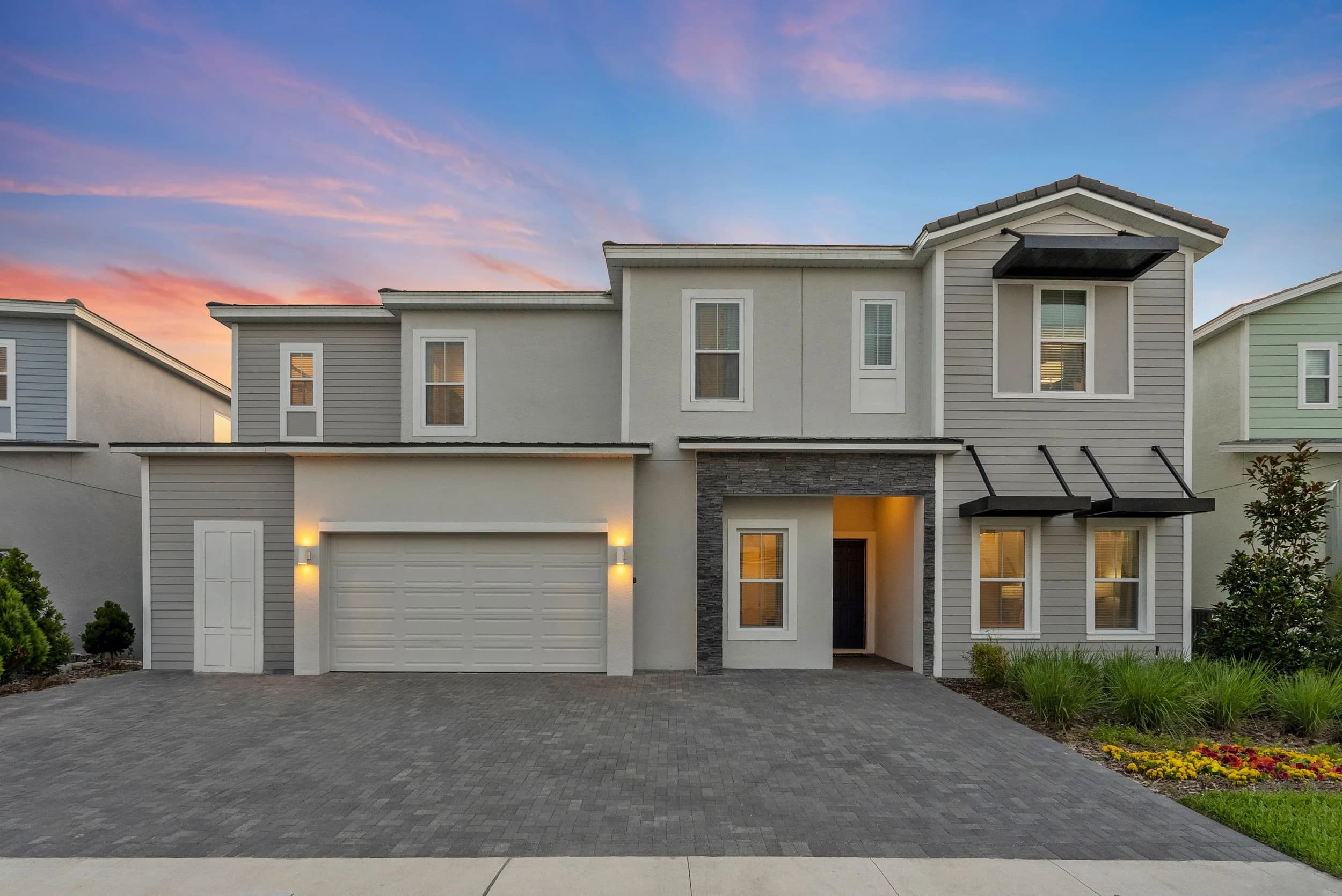
- Exterior, entry, parking, and any community amenities the guest gets access to.
The logic behind that opening frame is the same one covered in the post on choosing a hero photo. And for a house this large, stills alone leave guests confused about the layout — a 3D tour is doing real work here, which is the subject of the post on Matterport for luxury vacation rentals. Smaller, more conventional short-term rentals are a different exercise entirely, covered in the post on how Airbnb and VRBO photography differs.
If you manage resort homes and want a consistent approach across a portfolio rather than a different-looking gallery for every property, that is worth a conversation. Ready to book? Call or text (689) 600-2131 or get in touch.