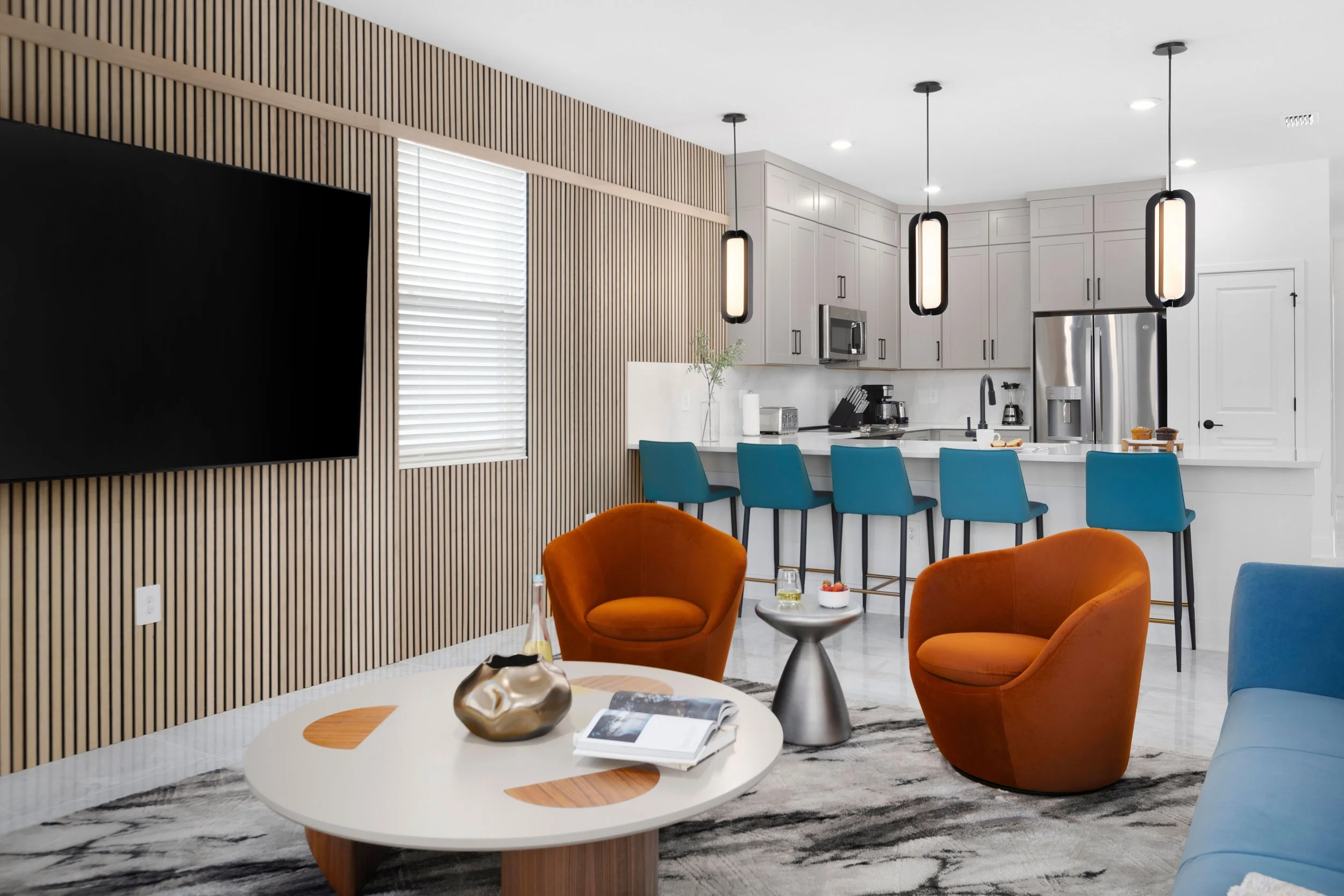
Most listing galleries have no captions at all, and the ones that do usually say "Kitchen." A caption field is a small piece of real estate, but it is the only place in the gallery where you get to say something the photo cannot.
What a Caption Is Actually For
Three jobs, in order of how often they matter.
Orienting the buyer. Galleries are a sequence of disconnected rooms. A buyer scrolling twenty-eight photos on a phone loses track of where they are in the house by image nine. A caption that says "Primary suite, first floor, rear of home" rebuilds the map in one line. This is especially useful in the sprawling one-story floor plans common across Central Florida, where three bedrooms photographed well look nearly identical.
Surfacing what the photo cannot show. A photo cannot tell you the flooring is porcelain tile rather than laminate, that the windows were replaced, that the room behind the closed door is a second laundry, or that the water beyond the lanai is a conservation pond rather than a retention basin. Those are the things buyers ask about, and answering them in the caption removes a phone call from the process.
Feeding search and accessibility. Caption text is machine-readable in a way an image is not. It travels with the photo through syndication, it can inform how a listing surfaces in a portal's search, and it gives screen-reader users something more than a filename. That is a real audience and a reason to write a caption even when the room is obvious.
How Many Photos to Caption
Not all of them. Caption everything and the captions stop being read.
Always caption the lead image, the primary suite, the kitchen, the outdoor space, and any room whose function is not immediately obvious.
Always caption anything with a detail worth naming — a workshop, a converted garage, a bonus room, an in-law suite, a boat lift.
Skip the obvious. A second guest bathroom does not need a caption that says "Bathroom."
Caption exterior and community images when the location matters: a view, a lot line, an amenity that belongs to the HOA rather than the home.
A gallery of thirty images where eight to twelve carry a real caption reads better than one where all thirty carry a label.
What a Good Caption Looks Like
Specific, factual, short. One line. Present tense. No sales language.
Better:
"Primary suite with private lanai access and dual walk-in closets"
"Kitchen: quartz counters, gas range, walk-in pantry behind left door"
"Second-floor bonus room, currently used as a home office"
"Screened lanai facing west; pool resurfaced 2023 per seller"
"Rear yard backs to conservation, no rear neighbors"
"Community pool and fitness center, HOA amenity"
Worse:
"Kitchen"
"Stunning gourmet chef's kitchen you have to see to believe"
"Perfect for entertaining family and friends"
"Brand new roof"
"Huge 20x18 great room"
"Great neighborhood, quiet street, ideal for a young family"
The difference is not tone for its own sake. Every item in the second list either says nothing, cannot be verified, or creates exposure.
What to Keep Out of the Field
Hype adjectives. Stunning, gorgeous, breathtaking, must-see. They occupy the space where a fact could go, and buyers discount them automatically.
Anything that describes people rather than property. Captions carry the same fair housing considerations as listing remarks. References to families, children, schools framed as a fit for certain buyers, religious institutions, "safe" or "quiet" neighborhoods, walkability framed around who lives there — these can read as steering. Describe the house and the lot. Let buyers decide who it suits.
Unverified condition claims. "New roof," "new HVAC," "recently remodeled." If you have not seen documentation, do not put it in a caption. If you have, attribute it and date it: "Roof replaced 2022, permit on file."
Dimensions you have not confirmed. Room sizes pulled from a builder brochure or eyeballed from a floor plan end up in a caption and then in a dispute. If a measurement is not from a source you trust, leave it out.
Anything you would not want syndicated. Captions travel with the photos to portals, brokerage sites, and aggregators, and they can persist longer than the listing does. Write them as if they will outlive the transaction.
Branding. Contact information, team names, and calls to action generally do not belong in a caption field any more than they belong burned into the image. Check your MLS rules; most treat the field as descriptive, not promotional.
The Practical Details Agents Trip On
Caption length limits vary considerably between MLSs — some allow a generous field, some cut you off in the neighborhood of a short sentence, and a few truncate silently in the portal display even when the MLS accepted the full text. Write the important part first so that a truncated caption still says something useful. "Primary suite with lanai access" survives a cutoff; "Located at the rear of the home is the primary suite, which features..." does not.
Two other habits worth adopting. Write captions once, in a document, while you are looking at the delivered gallery on a large screen — not while typing into the MLS at 11 p.m. And keep them with the photo file names your photographer delivered, so that when the listing is refreshed, relisted, or handed off, the captions come along instead of being rewritten from memory.
Captions are a ten-minute task on a listing that took a week to prepare. They are also the only part of the gallery where you get to answer a question before it is asked.
Ready to book? Get in touch or call us — we serve Orlando, Tampa Bay, and Central Texas.