When a buyer chooses a new-construction home, they are making two decisions at once: which house, and which community. Builders spend heavily documenting the first decision, model homes, floor plans, upgrade galleries, and often under-invest in the second.
That is a mistake, especially in master-planned Central Florida and Central Texas communities where the amenity package is frequently the actual differentiator between two builders offering similar square footage at similar prices.
What amenity photography is doing
Amenity images answer a question the model home cannot: what does daily life look like here beyond the front door?
For a family comparing two communities in Lake Nona or Wesley Chapel, the floor plans may be nearly interchangeable. The resort pool, the trail network, the dog park, the fitness center, and the event lawn are what actually differ. If those are represented by three phone snapshots on a subpage, the community is losing a comparison it might otherwise win.
The shot list that matters
A complete amenity package for a master-planned community usually includes:
Aerials
A hero frame establishing the community in its surroundings
The amenity center from above, showing scale and layout
Trail networks, lakes, and green space, which are almost impossible to convey from the ground
Proximity shots that show what is nearby without leaving the community
The amenity center
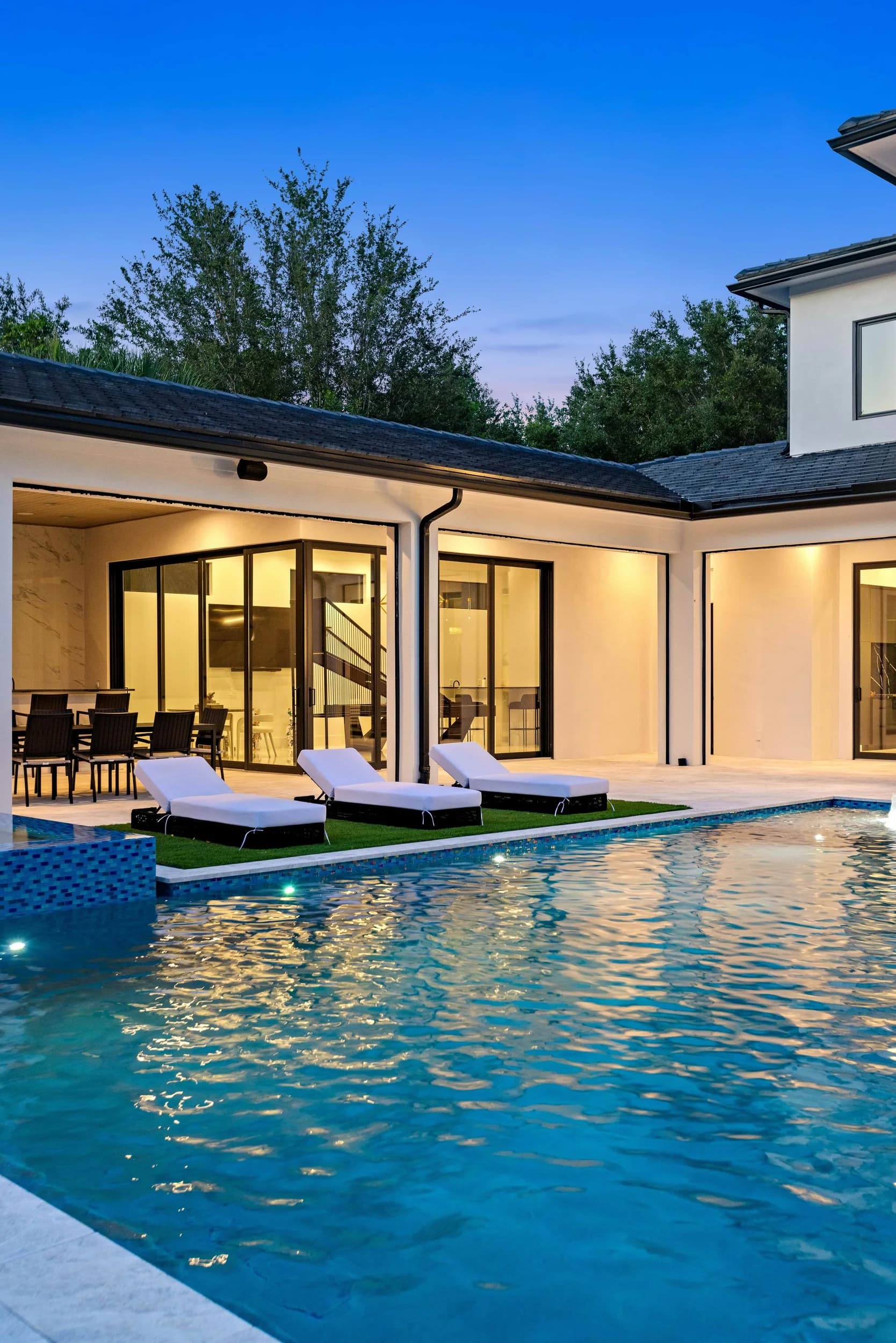
Exterior approach, ideally at golden hour or twilight
Pool from multiple angles, including at least one wide frame that shows the full deck
Interior clubhouse spaces: gathering rooms, kitchens, coworking areas
Fitness center, shot wide enough to show equipment variety
Everything else
Playgrounds, sport courts, and dog parks
Trailheads and walking paths, ideally with depth and leading lines
Entry monument and streetscape
Any signature feature the community is built around
Timing decisions that make or break the package
Amenity photography is unusually sensitive to timing, in ways interior photography is not.
Shoot amenities when they are empty or nearly empty. Early morning is usually best. A crowded pool is a scheduling headache and a release problem.
Landscaping needs to be mature enough. Shooting a new amenity center the week it opens produces images of thin sod and sapling palms. Waiting one growing season transforms the result. In Florida, that can be as little as six months.
Twilight is worth it for the amenity center specifically. A lit clubhouse and pool at dusk is the single strongest frame most communities have.
Seasonality matters less in Florida than in Texas. Central Texas communities photograph very differently in August than in April, and the difference is visible in the grass.
Aerials are not optional here
For community marketing, drone work is closer to essential than to a nice extra. A community is a spatial product. The relationship between homesites, amenities, water, and green space is the entire pitch, and no ground-level camera can show it.
A few practical notes for Florida builders:
Communities near MCO, Orlando Executive, TPA, and similar airports sit in controlled airspace and require LAANC authorization. Build lead time into the schedule.
Aerials date faster than anything else in the package. As a community builds out, last year aerials show empty lots that are now homes. Plan to re-shoot at meaningful buildout milestones, roughly 25 percent, 60 percent, and completion.
Shoot both stills and video. The video cut is what feeds social and the community website hero.
Using the images once you have them
The most common failure is not the photography, it is the distribution. Amenity images should be working in at least these places:
The community page on the builder website, above the fold
Every listing in the community, appended after the home photos
Sales center displays and print collateral
Social content, where amenity images consistently outperform interior shots
Realtor-facing materials, since agents selling your community need images they can use
That last point is underused. Builders who give cooperating agents a clean, licensed image library get their community marketed for free by people who do not work for them.
Licensing: settle it up front
Amenity photography is typically used more broadly and for longer than listing photography, across more channels and by more parties. Make sure the license you buy actually covers:
Use by the builder across all channels, indefinitely
Sublicensing to cooperating agents and the MLS
Use by the HOA or CDD once the builder exits
Use in paid advertising
Sorting this out at booking is far simpler than renegotiating in year three.
A reasonable starting budget
For a builder launching a new community, a sensible first package is: one aerial session, one amenity center session including twilight, and one trails-and-open-space session. That covers the core marketing needs and gives you a library to draw on for a year, with a planned re-shoot as buildout progresses.
Ready to plan your community amenity package? Get in touch or call us. We serve Orlando, Tampa Bay, Central Florida, and the Austin, San Antonio, and Dallas metros.